
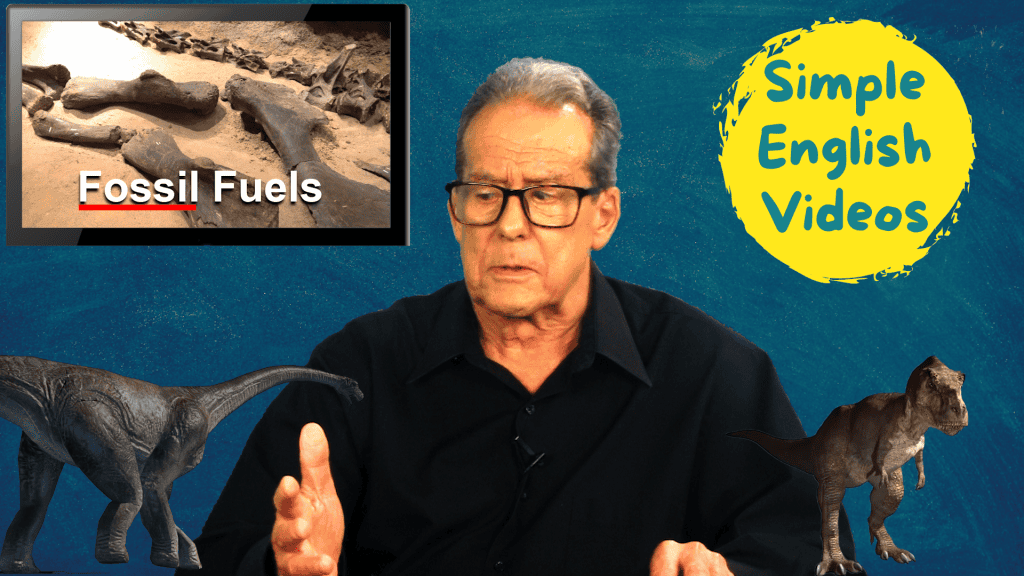
Jay, accompanied by some ancient creatures, tells the story of Climate Change with vocabulary vital to anyone interested in how the world is changing as result of human activity. Watch this video on YouTube at https://youtu.be/mYFcP11wpz0 or click the YouTube image below.
Transcript
Climate change is in the news every day. People are dying from the heat, drowning in floods
and fleeing horrible wildfires. I’m Jay. And today’s lesson is about the language of climate change. We talked about climate change in our free weekly conversation on zoom.
How is climate change affecting our lives?
All of us here suffering because of heat wave, and we reduced the time we spent outside.
We spend out our time all the day we are inside.
So my friend Irene in Belgrade, Serbia, is suffering from the heat wave on the very day
we’re recording this lesson. Another guest in our lives, zoom meeting, Roxana, lives in the Middle Eastern country of Oman, where it’s always hot and where it rarely rains,
so additional heat from climate change hardly changes her everyday life. And for her,
finding cool places is the answer.
It’s okay. You just get used to it. You will go for the closest options of entertainment like the mall, because the Middle East is famous for the mall area where you can spend your time there. And what I personally do is that when I get bored of being at home and using my AC day and night, I just give a break, and go to mall. I do window shopping,
then I come back to continue my life. So it’s okay.
We human beings need energy to power our machines, our cars, heat and cool
our homes, run our factories. And for hundreds of years now, we’ve been doing that
primarily with fossil fuels. We extract fossil fuels from the Earth. These fuels include coal, crude oil and methane gas.
How did fossil fuels get buried deep in the Earth? Well, the word fossil gives us a clue. A fossil is what is left of a plant
or animal that died thousands upon thousands, even millions of years ago. Think of the fossils scientists
have found from dinosaurs. The creatures and the plants that lived millions of years ago are now buried deep under the earth,
under great pressure. And that pressure changes those plants and animals back into their basic elements of carbon, hydrogen and oxygen,
the building blocks of life. But in certain combinations, these elements can form coal, which is mostly carbon, crude oil and methane gas. And we find these
by digging deep into the Earth. But when we burn coal or the products that come from crude oil, like gasoline, or in British English, that’s petrol, the result is carbon dioxide, a gas made of carbon and oxygen. When we humans breathe out, we exhale carbon dioxide. Now, before we humans started burning fossil fuels for energy, we relied on plants to absorb carbon dioxide and release oxygen. That’s what plants do. And the more green plants and forests we have on Earth, the more carbon dioxide gets absorbed
and the more oxygen is released. But over time, we humans have burned lots of fossil fuels, and at the same time, we have cut down forests all over the world
to give us wood to build things. So now there’s more carbon dioxide in the world and fewer plants to give us oxygen. Methane, which we also extract from deep in the Earth and is used for cooking and heating, for example, is sometimes released into the air naturally. It is the product of decaying organic material. Swamps around the world, for example, put methane gas into the atmosphere. Oh, and cows release a lot of methane gas as part of their process of digesting food.
These gases surround the Earth and they act just like a greenhouse, creating what we call the greenhouse effect. What’s a greenhouse? You’ve probably seen glass or plastic structures where plants, and vegetables are grown even in the winter. The glass and the plastic trap the heat of the sun, allowing plants inside the greenhouse to grow all year round. But greenhouse gases surround the earth now, and they also trap the heat of the sun. Carbon dioxide and methane are among those gases that are not allowing heat to escape. And so the Earth is getting hotter and hotter, and there are fewer forests to give us oxygen from carbon dioxide. To make matters worse, as the Earth warms, heated water from our oceans, lakes, and rivers becomes water vapor, and that joins the other gases to prevent heat from escaping the earth. Water vapor.
So let’s review the vocabulary of climate change in this lesson.
Climate change: The way weather has changed over a long period of time around the world.
Fossil fuels: The fuel we take out of the earth to provide energy for our cars and homes and factories coming from ancient plants and animal life.
Greenhouse gases The result of burning fossil fuels for energy.
The greenhouse gas effect: The trapping of heat in the Earth’s atmosphere by the gases released by burning fossil fuels, causing temperatures around the world to rise.
Now, in our next lesson, we’ll look at the vocabulary that lets us understand how we can fix the problems created by the climate change humans have introduced by burning fossil fuels. By the way, we’re discussing these and other really interesting topics every week in our Sunday Live conversations with me. These are zoom meetings. They’re absolutely free and you can watch them live every week, join in and participate and have a lot of fun. You can learn about this by clicking the video link at the end of this video, or by looking at the description to this video on YouTube.
So I’ll see you in the Simple English Videos lesson next week, and hopefully in our zoom conversations on Sundays.
This is Jay from Simple English Videos saying take good care.
Bye now.